Czech artist Alžběta Josefy completed an artistic residency in the Israeli city of Arad, located at the edge of the Negev and Judean deserts. During her stay, she explored the relationship between landscape, body, and space, which will culminate next year in a site-specific installation in the desert. In this interview, she reflects on her residency experience, the inspiration of the desert environment, and her creative process.
Could you tell us a little more about how your residency went and what you focused on in Arad?
The residency was exceptional, particularly because of the landscape. Lately, I’ve been fascinated by deserts, and the city of Arad is located in southern Israel, on the border between the Negev and Judean deserts. I spent most of my time in a contemplative mood in the residence house with a studio, and as often as possible I went for walks in the desert, which was only a 20-minute walk from the house. I therefore devoted most of this preparatory residency period to spending time in nature, experiencing the landscape, and reflecting on the theme of liminal situations, which is the subject of the in-situ object I will be creating there next year.
During your residency, you organized a creative workshop for the public at ACAC. How did it go, and how was your overall experience working with the ACAC team?
At the workshop held at the ACAC Contemporary Art Center, we invited the local community to explore the creative potential of sand. I collected it before dawn, and participants created images by gluing grains of sand onto a prepared surface. Each participant could decide whether to create an abstract composition, a symbolic threshold, or a personal motif inspired by the desert landscape. We chose a theme identical to the title of the Czech Centers’ long-term project “Safer Spaces,” which focuses on the concept of safety on both the individual and societal levels, particularly through culture and art. At first, I wasn’t entirely sure if the theme was too powerful, given the overall context and situation in the country… but on the contrary—it was well-received and sparked interesting conversations.
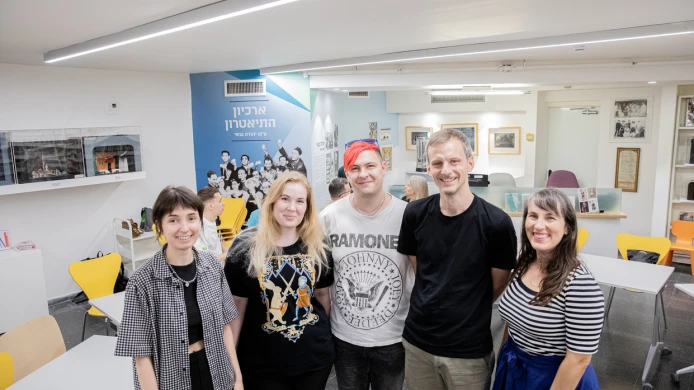
The people at the Arad Contemporary Art Center, led by Lea Abir—the center’s artistic director and a curator working in the field of contemporary art—were enriching not only professionally but also on a personal level. I then had the opportunity to visit several exhibition openings in Tel Aviv with Lea, and I also attended the opening of the Rahat Art Gallery with her and her students. The city of Rahat is the largest Bedouin settlement in the world, and this gallery is the first in the city, founded to support emerging local artists and creators from the region. It initiates intercultural dialogue and community projects and connects traditional crafts with contemporary art.
What personal value did the residency hold for you? How did you find the creative process in the desert environment?
For me, personal gain and creative gain are one and the same. There’s no distinction between them. What I discovered there while reflecting on my work was also a discovery about myself, and vice versa. That’s what I love about art—that it offers this. And the desert, as I’ve already mentioned, has a very intense effect on me. So any processes, whether creative or psychomental, were closer to my awareness. Nowhere else but in the desert have I experienced this kind of mental state.
The residency will continue next year, culminating in the installation of a permanent structure in the desert near Arad. Have you already thought through how you’ll approach it?
I went there with a certain vision already in mind, because a sort of proposal—or rather, an idea—had already been presented during the selection process. But I knew I had to arrive with an open mind, assuming that the place itself would reveal what it required.
My intention is to find a sensitive yet precise definition of the space—a zone that invites a certain kind of experience, such as a more intense awareness of the connection between space and the body, or some form of inner reflection. I would likely work with a square form marked out on the ground. I find the square particularly wonderful because all its sides are of equal length, and it thus relates equally to all cardinal directions—it does not favor any of them.
But I knew from the start that I had to be careful. I didn’t want the work to be an insensitive intrusion or, ultimately, a crude form of colonization. Because the desert is beautiful in and of itself, and one very quickly realizes that its beauty lies precisely in its simplicity… so my thinking about the site now revolves mainly around this question: how much—or how little—to bring into it.